
Tuesday, September 22nd
4:30 PM
Open to adults & teens
Our September book is The Sun Also Rises by Ernest Hemmingway.
Published in 1926, The Sun Also Rises by Ernest Hemingway follows a group of American and British expatriates living in Europe during the years following World War I. Narrated by journalist Jake Barnes, the novel moves from the cafés and nightlife of Paris to the bullfighting festival in Pamplona, Spain. Jake travels among a circle of friends whose drinking, relationships, jealousies, and restless pursuit of pleasure gradually reveal a generation struggling to find direction and meaning after the devastation of war.
At the center of the novel is Jake's complicated relationship with Lady Brett Ashley, a charismatic and independent woman whom he loves but cannot fully be with because of a wartime injury that left him impotent. Their relationship unfolds alongside conflicts involving Brett's other romantic partners and the increasingly destructive behavior of their social circle. Beneath the parties, travel, drinking, and bullfighting lies a persistent sense of disillusionment and emotional isolation. Hemingway's restrained prose often leaves the characters' deepest feelings unstated, making silence and implication as important as what they openly say.
The Sun Also Rises became one of the defining novels of the postwar "Lost Generation" and helped establish Hemingway as a major American writer. Nearly a century after its publication, the novel offers opportunities to discuss masculinity, sexuality, friendship, trauma, alcohol, class, antisemitism, and the search for purpose after war. Some of its language and portrayals reflect prejudices of its period and can be difficult for modern readers. At the same time, its depiction of people attempting to escape emotional pain through travel, relationships, alcohol, and constant activity raises enduring questions about whether changing one's surroundings can ever resolve conflicts carried within oneself.
Tuesday, October 27th
4:30 PM
Open to adults & teens
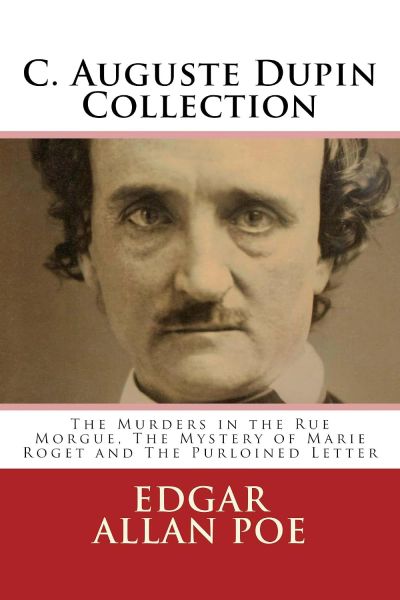
Our October reading is the C. Auguste Dupin Collection, a series of short detective stories by Edgar Allan Poe.
Published between 1841 and 1844, Edgar Allan Poe's three stories featuring C. Auguste Dupin—The Murders in the Rue Morgue, The Mystery of Marie Rogêt, and The Purloined Letter—are among the earliest works of modern detective fiction. Set primarily in Paris, the stories follow the brilliant and eccentric Dupin as he solves mysteries through careful observation, logical reasoning, and an ability to reconstruct the thoughts and actions of others. An unnamed narrator, who is Dupin's friend and companion, relates each investigation.
The three stories explore different kinds of mysteries. The Murders in the Rue Morgue presents a seemingly impossible and exceptionally violent double murder; The Mystery of Marie Rogêt examines the disappearance and death of a young woman and was inspired by an actual unsolved murder in New York; and The Purloined Letter centers on the search for a stolen document hidden in an unexpected manner. Throughout the series, Dupin repeatedly succeeds where conventional police methods fail because he considers not only physical evidence but also human behavior, perspective, and motive.
Poe's Dupin stories helped establish many conventions that later became familiar features of detective fiction: the exceptionally intelligent amateur investigator, the admiring narrator, the less perceptive police, the apparently impossible crime, and the eventual explanation of how the mystery was solved. Dupin became an important literary predecessor to detectives such as Sherlock Holmes and Hercule Poirot. Nearly two centuries later, the stories offer readers an opportunity to examine the origins of the detective genre while considering Poe's fascination with logic, psychology, observation, and the sometimes uncertain boundary between what appears impossible and what can ultimately be explained.